
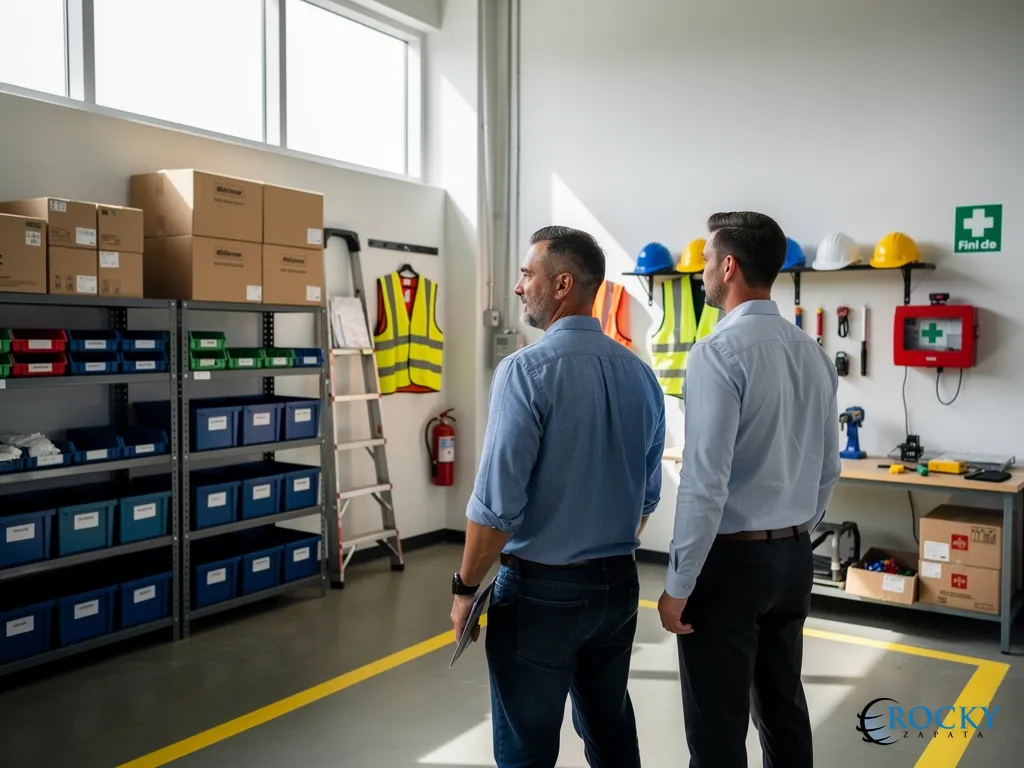
Safety consulting for small and mid-sized businesses delivers OSHA compliance training, written safety programs, and on-site hazard assessments through one relationship rather than piecemeal vendors. Rocky Zapata Safety Consulting has provided these services, helping employers reduce workplace incidents and losses while protecting profitability. OSHA's On-Site Consultation Program prevents over 8,700 workplace injuries annually.

Key Takeaways

  • OSHA's On-Site Consultation Program prevents over 8,700 workplace injuries and saves the U.S. economy almost $1.5 billion annually.
  • Rocky Zapata Safety Consulting has delivered OSHA compliance training, written safety programs, and on-site hazard assessments.
  • A complete small business safety program begins with a comprehensive workplace assessment identifying hazards, regulatory requirements, and operational needs.
  • Mid-sized employers carry real exposure across machine guarding, lockout/tagout, powered industrial trucks, and hazard communication, often across multiple sites.

Why Do Small Businesses Need Safety Consulting?

Small businesses face serious workplace hazards without the dedicated safety staff larger corporations employ. A single serious incident triggers OSHA citations, legal liability, and operational disruption that many smaller employers cannot absorb.

The financial stakes are immediate. Adhering to OSHA regulations ensures a safe working environment and protects companies from legal repercussions and financial losses. Our consulting work has focused squarely on this connection between compliance and profitability. We reduce losses and workplace incidents through structured safety programs built for each client's specific operation.

What hazards do small and mid-sized employers face daily?

Mid-sized employers carry real exposure across machine guarding, lockout/tagout, powered industrial trucks, and hazard communication. These hazards often spread across multiple buildings or jobsites. Without systematic oversight, gaps multiply quickly.

How much do workplace injuries actually cost small businesses?
The OSHA On-Site Consultation Program prevents over 8,700 workplace injuries and saves the U.S. economy almost $1.5 billion every year. Those numbers reflect real costs hitting individual businesses: workers' compensation premiums, lost productivity, equipment damage, and regulatory fines. For a small operation, one serious injury threatens the entire enterprise.

Small business safety consulting bridges the gap between regulatory requirements and practical implementation. Rocky Zapata Safety Consulting provides comprehensive safety consulting services. Our approach to smaller employer safety solutions treats every client's operation as unique. Rocky Zapata Safety Consulting offers a wide range of specialized services referenced under rockyzapata.org/safety, including OSHA compliance training, construction safety management, safety training programs, safety staffing solutions, and thorough safety program assessments. Learn more about our safety consulting approach and how we tailor programs to each client.

What Should a Small Business Safety Program Include?

A complete small business safety program begins with a comprehensive assessment of the workplace. That assessment identifies specific hazards, regulatory requirements, and operational needs before any written program takes shape. Skipping this step leaves gaps that surface later as citations, injuries, and lost production time.

Our small business safety consulting practice builds every program on that assessment foundation. We then develop tailored safety programs matched to the actual work your employees perform, not a generic template pulled from a shelf. For a small business safety program guide, the core components follow a predictable order.

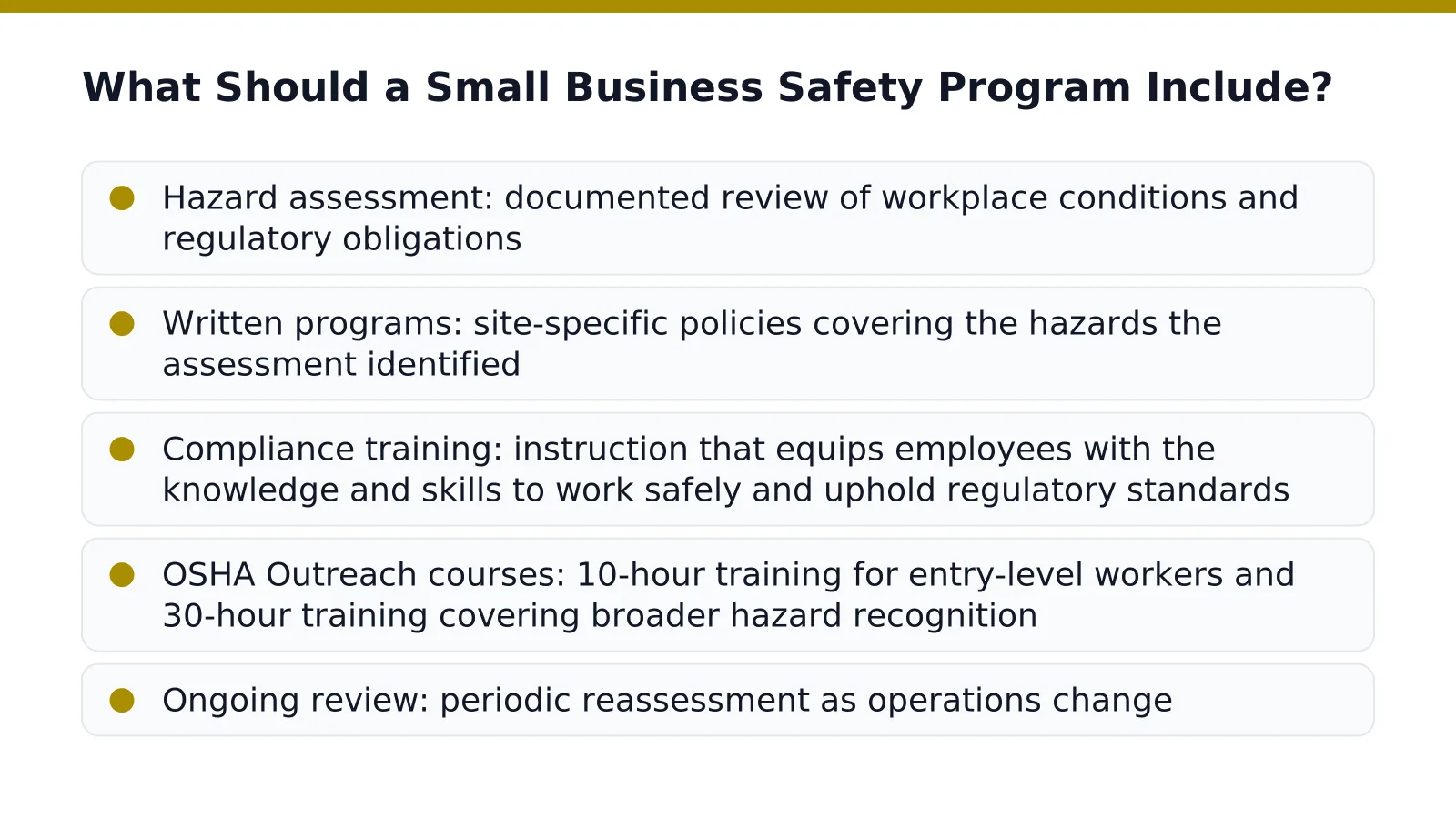
  • Hazard assessment: documented review of workplace conditions and regulatory obligations
  • Written programs: site-specific policies covering the hazards the assessment identified
  • Compliance training: instruction that equips employees with the knowledge and skills to work safely and uphold regulatory standards
  • OSHA Outreach courses: 10-hour training for entry-level workers and 30-hour training covering broader hazard recognition
  • Ongoing review: periodic reassessment as operations change

Which Training Courses Fit Entry-Level and Experienced Workers?

Course selection depends on the audience. The 10-hour course suits entry-level workers who need core hazard awareness. The more comprehensive 30-hour course covers a broader range of safety topics and deeper hazard recognition for supervisors and seasoned crews. We deliver this instruction through on-site safety training workshops at your facility.

How Do Language Barriers Affect Program Delivery?

Training only works when every employee understands it. Rocky Zapata Safety Consulting offers a range of compliance training options designed to meet the diverse needs of businesses. That matters in multicultural workforces where mixed-language crews are common.

These smaller employer safety solutions keep affordable safety services within reach for growing operations. Contact our team to scope an assessment for your site.

How Do You Choose the Right Safety Consulting Firm?

Choosing the right safety consulting firm starts with understanding the components and services a consultant offers, because those details directly affect a company's operational integrity. A firm that covers the full scope of safety work serves smaller employers better than one that handles a single piece of the job.

The selection process carries real challenges. Buyers must navigate a complex regulatory environment while aligning safety strategies with their own organizational needs. A firm that works as an ongoing partner, rather than handing over a one-time audit, reduces that burden. Look for a defined process you can see and track from start to finish.

What Services Should a Small Business Safety Program Guide Cover?

A small business safety program guide should address training, written programs, inspections, and compliance support in one relationship. Small business safety consulting built this way keeps smaller employer safety solutions practical instead of fragmented. Affordable safety services deliver the most value when they consolidate these needs rather than selling them piece by piece.

How Do You Compare Safety Consulting Providers?

Weigh each provider against the same criteria before you commit:

  • Scope: Does the firm cover training, written programs, inspections, and citation support together?
  • Partnership model: Does the firm stay engaged after the first audit?
  • Process visibility: Can you see and track the defined process?
  • Regulatory depth: Does the firm navigate the complex regulatory environment on your behalf?

Rocky Zapata Safety Consulting offers a wide selection of services, including OSHA compliance training, construction safety management, safety training programs, safety staffing solutions, and thorough safety program assessments. That breadth supports ems for smbs that need one accountable partner across multiple sites and hazards.

What Are the Costs of Hiring a Safety Consultant?

A full-time safety hire typically runs $85,000 to $150,000 per year plus benefits, a figure that rarely makes sense for mid-sized operations. Consulting arrangements replace that fixed payroll burden with a defined scope of work. The savings show up in overhead, not just in the fee.

Cost structures vary by engagement type. Most employers weigh three options:

  • Staff position: $85,000 to $150,000 annually plus benefits, per Lancaster Safety Consulting's 2026 market analysis.
  • On-site consultation: no-cost, confidential hazard reviews that the OSHA On-Site Consultation Program provides primarily for smaller businesses.
  • Contracted consulting: a scoped engagement covering training, written programs, and compliance support.

What Drives the Price of a Consulting Engagement?

Scope determines cost more than any other factor. A single written program costs far less than ongoing compliance management across multiple sites. Our safety consulting cost factors guide breaks down how scope, site count, and industry shape the investment.

Why Do Some Consulting Relationships Fail?

Consulting practices fail for business reasons, not technical ones. SafetyRegulatory.com reports that consultants fail because they undercharged, skipped contracts, and could not find clients. Employers feel that instability directly. A firm that undercharges cannot sustain the service level a small business safety program guide demands.

Rocky Zapata Safety Consulting approaches cost differently. We build affordable safety services around tailored programs that improve client profitability by reducing losses and workplace incidents. That outcome focus keeps smaller employer safety solutions within reach for growing operations.

How Does Outsourcing Safety Improve Your Bottom Line?

Outsourcing safety management reduces direct costs and protects revenue. Effective safety management fosters a culture of safety while ensuring legal compliance, which prevents the fines, litigation, and downtime that erode margins.

The financial case for outsourcing rests on three measurable outcomes:

  • Reduced incident costs: Fewer injuries mean lower workers' compensation premiums and less lost productivity.
  • Regulatory protection: Compliance gaps trigger OSHA citations that carry penalties and repeat-inspection exposure.
  • Operational continuity: A structured safety program keeps crews working instead of idled by stop-work orders or investigations.

Our expertise ensures businesses achieve optimal safety compliance and operational efficiency. That combination matters because mid-sized employers rarely have the internal bandwidth to manage both.

What Does a Safety Management System Actually Deliver?

A safety management system converts scattered policies into one repeatable framework. The framework covers hazard identification, risk assessment, and performance monitoring. We help clients build these systems through a comprehensive guide to safety management systems that walks through each core component.

How Do Smaller Employers Access This Level of Support?

Smaller employer safety solutions work best when delivered on-site and tailored to the operation. We serve businesses across South Florida, West Coast Florida, and Central Florida. Our team provides on-site training and consulting at each client's location throughout these regions.

Affordable safety services do not require a full-time safety director on payroll. Outsourcing delivers the same expertise at a fraction of that fixed cost. The result is a compliant operation without the overhead burden.

FAQ

Why do small businesses need safety consulting?

Small businesses face serious workplace hazards without dedicated safety staff, and one serious incident triggers OSHA citations, legal liability, and operational disruption many smaller employers cannot absorb.

What hazards do mid-sized employers face?

Mid-sized employers carry real exposure across machine guarding, lockout/tagout, powered industrial trucks, and hazard communication, often spread across multiple buildings or jobsites where gaps multiply without systematic oversight.

What services does Rocky Zapata Safety Consulting provide?

Rocky Zapata Safety Consulting delivers OSHA compliance training, written safety programs, and on-site hazard assessments through one relationship rather than piecemeal vendors, serving clients.

Conclusion

Weigh each provider against the same criteria, then choose the partner that consolidates training, written programs, inspections, and compliance support into one accountable relationship. That decision protects margins, prevents citations, and keeps crews working. Rocky Zapata Safety Consulting builds tailored programs that improve profitability by reducing losses and workplace incidents, delivering smaller employer safety solutions without the overhead of a full-time hire.