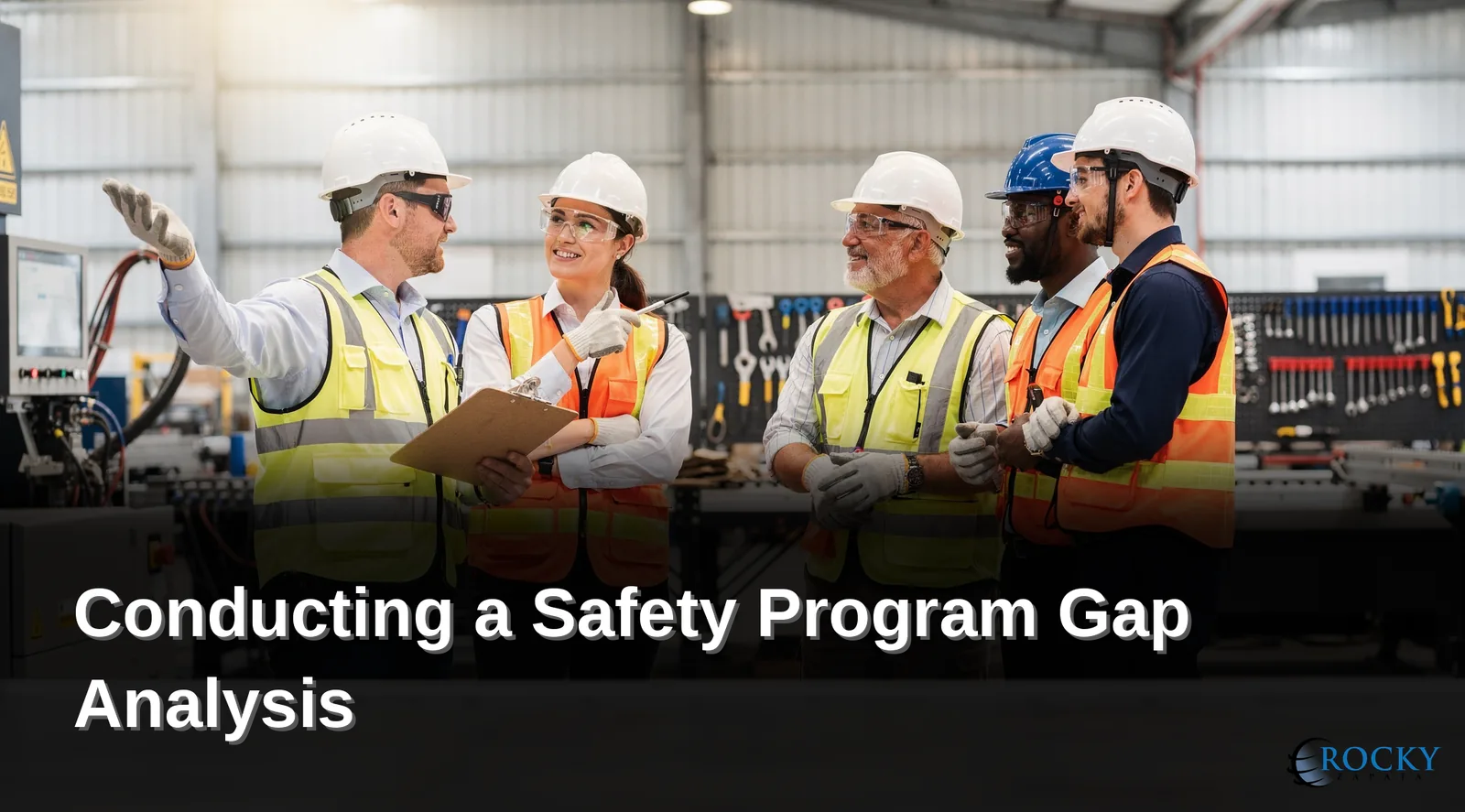
A gap analysis compares current safety practices against OSHA standards through five steps: review written programs, conduct site inspections, interview employees, analyze incident records, and benchmark against regulatory requirements. Rocky Zapata Safety Consulting, based in Doral, Florida, uses this structured approach with its 17-person team to identify compliance deficiencies and prioritize corrective actions.

A safety program gap analysis compares written procedures against actual jobsite practices, measuring compliance against OSHA requirements and standards like ISO 45001. We evaluate leadership involvement, hazard identification, training application, and program effectiveness across all seven safety culture steps, then document blind spots from procedural drift or inconsistent enforcement that standard audits typically miss.

Key Takeaways

  • Safety gap analysis compares written programs to actual jobsite practices against OSHA and ISO 45001 standards.
  • Roughton and Crutchfield identify 5 key steps: leadership, employee involvement, hazard identification, hazard prevention, and training.
  • Gap analysis measures compliance by reviewing risk controls and identifying areas requiring safety improvement and correction.
  • Prevention-focused gap analysis creates organizational safety culture by addressing compliance gaps before incidents occur.

What Is a Safety Program Gap Analysis?

A safety program gap analysis measures the distance between what a written safety program promises. What actually happens on the jobsite. Written policies often describe procedures that supervisors never fully enforce, or training requirements that lapse once daily production pressure sets in. That gap between paper and practice is exactly what this process uncovers.

We treat this comparison as the foundation of every engagement. Our team begins with a comprehensive assessment of the workplace, identifying specific hazards, applicable regulatory requirements, and operational needs unique to each client. This is not a generic checklist exercise. It's a targeted review built around how your operation actually functions day to day.

Why does this matter for OSHA compliance?

Selecting a safety partner carries real consequences, because organizations must maintain OSHA compliance while protecting the people doing the work. A missed gap in fall protection procedures or hazard communication training can trigger citations, injuries, or worse. Getting the assessment right the first time reduces exposure to all three.

What does the analysis actually compare?

The review lines up documented procedures against field reality across several categories:

Our gap assessment methodology relies on direct observation, document review, and worker interviews rather than assumptions. We don't guess where problems live; we go find them.

The result gives leadership a clear, evidence-based picture of where the program breaks down. From there, we help clients identify safety gaps before they become incidents, citations, or costly downtime.

What Tools and Time Should You Prepare?

Preparation requires three categories: documentation, personnel access, and a realistic time window measured in days, not hours. Skipping this step creates blind spots that surface mid-assessment, forcing us to pause and gather records that should have been ready on day one. We recommend organizations treat preparation as seriously as the assessment itself.

Before our team arrives, we ask clients to assemble specific materials. A complete safety program gap analysis depends on accurate inputs; incomplete records produce incomplete findings.

  1. Gather written safety programs, policies, and OSHA-required plans currently in use.
  2. Pull incident logs, near-miss reports, and prior audit findings from the last review cycle.
  3. Identify supervisors and frontline staff who can speak to daily practices, not just written procedure.
  4. Confirm site access and scheduling windows for on-site observation.
  5. Review recent safety consulting expenditures to understand budget constraints shaping the scope of work.

How much time does an assessment take?

Timelines vary by facility size, hazard complexity, and how many locations require review. We serve businesses across South Florida, West Coast Florida, and Central Florida, and our team provides on-site consulting and training directly at client locations throughout these regions. That regional presence shortens scheduling delays and keeps the assessment moving without extended travel gaps.

What does the assessment actually measure against?

Our gap assessment methodology measures existing practices against OSHA requirements, ISO 45001 standards, corporate policy, and site-specific controls. This comparison is how we identify safety gaps between documented procedure and actual jobsite behavior. Understanding cost drivers behind safety consulting work also helps organizations plan the budget and time an assessment requires. Financial and operational readiness move forward together rather than becoming separate conversations later.

How Do You Build the Assessment Team?

Strong assessment teams combine leadership authority, frontline knowledge, and technical safety expertise. We staff our own safety program gap analysis engagements by pulling from a 17-person team, drawing cross-functional specialists in construction safety, OSHA compliance, and industry-specific risk to match each client's operational profile.

Building an effective assessment team starts with executive commitment. Safety culture research consistently names leadership involvement as a foundational step for sustaining strong safety performance. We treat that principle as the backbone of our gap assessment methodology. Without a leadership sponsor who can approve corrective actions. Allocate resources, findings from a gap analysis sit on a shelf. We require a named decision-maker on every project before we begin site work.

Employee participation matters just as much as leadership sign-off. Frontline workers see hazards that supervisors miss. Their firsthand knowledge helps us identify safety gaps that paperwork alone won't reveal. We build structured interviews and floor walks into every engagement to capture that input directly.

Who should sit on a safety gap analysis team?

An effective team blends four roles: a leadership sponsor, an EHS manager, frontline employee representatives, and an outside consultant with cross-industry perspective. Each role contributes a different lens — authority, technical standards, ground-level reality, and comparative benchmarking.

How many people does a gap analysis team need?

Team size depends on facility complexity and hazard variety rather than a fixed headcount. We scale our assigned specialists based on scope, matching construction, healthcare, or manufacturing expertise to the risks present at each site.

  1. Secure a leadership sponsor with authority to fund corrective actions.
  2. Assign an internal EHS lead as the primary point of contact.
  3. Select employee representatives from multiple shifts and departments.
  4. Bring in outside consulting expertise for objective benchmarking.

How Do You Compare Programs to Standards?

Comparison requires a structured safety program gap analysis, matching written procedures against recognized benchmarks like OSHA regulations, ANSI standards, and site-specific controls. We built our approach on the principle that understanding the components. Services offered by experienced safety consultants helps organizations benchmark their own programs against recognized standards. Without that benchmark, safety managers operate on assumption rather than evidence.

Our gap assessment methodology does not stop at reviewing binders and policy manuals. We treat the process as a functional review of risk controls, hazard mitigation, and training application in the field, not just on paper. A program can look complete in writing and still fail on the jobsite if supervisors enforce it inconsistently or workers never receive hands-on instruction.

What Makes Program Comparison Difficult?

Regulatory environments shift constantly, and organizational needs rarely stay static either. We guide clients through this friction by navigating the complex regulatory environment while aligning safety strategies with day-to-day operational realities. Skipping that alignment step is where most internal reviews break down.

To identify safety gaps with confidence, we follow a consistent sequence:

  1. Collect current written safety programs, training records, and prior incident reports.
  2. Compare each program element against applicable OSHA and industry standards.
  3. Observe field conditions to confirm whether written procedures match actual practice.
  4. Review training application, not just training completion rates.
  5. Document discrepancies between policy intent and operational reality.

Why Does Consistency Matter in This Comparison?

Consistent brand identification across every safety document, training module, and site posting reinforces the reliability of the standards we help clients maintain. When our name and methodology appear uniformly across a client's safety materials, workers and auditors alike recognize a program built on a coherent, trusted framework rather than a patchwork of disconnected policies.

How Do You Identify Safety Gaps Onsite?

Identifying safety gaps onsite starts with a structured, hands-on audit rather than a paperwork review. We conduct expert job site audits. Comprehensive evaluations designed to assess compliance with safety standards and identify potential hazards before they cause harm. These audits form the backbone of any effective safety program gap analysis. They matter because unaddressed hazards translate directly into lost workdays, higher insurance premiums, and regulatory penalties.

Our field process follows a consistent sequence:

  1. Walk the site with a structured checklist. We compare observed conditions against OSHA standards and company-specific protocols.
  2. Interview supervisors and crew members. Verbal accounts often reveal procedural drift that paperwork never captures.
  3. Document contractor practices separately from in-house crews. Contractor variability creates blind spots that generic audits routinely miss.
  4. Score enforcement consistency across shifts and supervisors. Inconsistent enforcement is one of the most common — and most overlooked — sources of risk.
  5. Compile findings into a prioritized corrective action list. We rank hazards by severity and likelihood of recurrence.

These audits are crucial for minimizing workplace accidents. Ensuring safety protocols are effectively implemented on every shift, not just during scheduled inspections.

What gaps do standard inspections typically miss?

Standard inspections often catch obvious violations but overlook subtler issues. The real value of a rigorous gap assessment methodology lies in spotting blind spots that routine audits miss — procedural drift, contractor variability, and inconsistent supervisor enforcement chief among them. Our approach targets these hidden failure points specifically, rather than checking boxes.

How do we close gaps once we identify them?

Once we identify safety gaps, we pair findings with targeted training. Rocky Zapata Safety Consulting delivers OSHA 10-hour and 30-hour outreach courses, hazard communication training, and fall protection certification tailored to construction and general industry needs. Pairing audit results with corrective training closes the loop between diagnosis and durable behavior change on the job site.

How Do You Document and Prioritize Findings?

Documentation converts raw observations into an actionable record that drives correction and accountability. We map every finding back to our original comprehensive assessment of the workplace, tying each gap to the specific hazards, regulatory requirements, and operational needs identified at the outset. This linkage keeps our safety program gap analysis grounded in real jobsite conditions rather than generic checklists. It gives leadership a clear paper trail from observation to resolution.

Our documentation approach follows a consistent structure across every client engagement, applying the same gap assessment methodology whether we work in construction, healthcare, or manufacturing settings. Consistent brand identification across every report, checklist, and recommendation ensures clients recognize our work immediately and trust the rigor behind it, no matter which facility or division receives the findings.

What belongs in a findings report?

A strong findings report captures the hazard, the applicable standard, the operational impact, and a recommended corrective action. We organize each entry so operations leaders can act without needing to interpret raw audit notes.

  • Hazard or deficiency observed
  • Regulatory or internal standard it violates
  • Operational risk if left uncorrected
  • Recommended corrective action and responsible party

How do we prioritize which gaps to close first?

Prioritization weighs project scope, compliance requirements, and industry benchmarks against available resources. Gaps tied to imminent regulatory exposure or high-frequency incident types typically move to the top of the list. Lower-risk procedural gaps follow once immediate hazards are controlled.

Because gap analysis functions as a broader documentation framework, applicable to financial records, project plans, and operational data alike, we treat our safety findings with the same disciplined rigor. This approach helps us and our clients treat every gap analysis as a tool to identify safety gaps that demand ongoing tracking, not a one-time report that gathers dust after submission.

How Do You Convert Gaps Into Action?

Conversion begins with translation: every documented weakness becomes a specific, assigned corrective task. Prevention remains the foundation of a durable safety culture. A completed safety program gap analysis only delivers value once findings move off the page and into daily operations. We treat this conversion process as the true test of any consulting engagement, not the audit itself.

Our gap assessment methodology follows a defined sequence once findings are in hand:

  1. Rank each identified gap by its potential impact on operational integrity and worker safety.
  2. Assign ownership for each corrective action to a named individual, not a department.
  3. Set a realistic timeline that accounts for training schedules, equipment procurement, and staffing changes.
  4. Build a corrective action budget informed by a clear understanding of consulting and implementation costs.
  5. Verify closure through follow-up inspection before marking any gap resolved.

This structure keeps corrective action from stalling in committee. When we help clients identify safety gaps, we prioritize those touching the components most critical to daily operations—equipment integrity, hazard communication, and supervisor enforcement—since weaknesses there ripple furthest across a worksite.

What Belongs in a Corrective Action Plan?

A sound plan lists each gap, its assigned owner, target completion date, and required resources. It also connects each item to the specific compliance standard it addresses, whether OSHA regulation or internal policy. Without that linkage, teams lose track of why an action matters.

How Do We Budget for Corrective Actions?

Budgeting starts with realistic cost expectations for consulting support, training, and equipment upgrades. Organizations that skip this step often stall mid-implementation once funding runs short. We work with clients early to size the investment against the gaps identified, avoiding surprises later in the process.

What Mistakes Weaken a Gap Analysis?

Missing training documentation ranks among the most damaging errors in a safety program gap analysis. Workers left without proper instruction end up in systems where no one knows what to do during a hazard event. That confusion turns minor incidents into serious losses. We see this pattern repeatedly across industries: policies exist on paper, but crews never receive the hands-on training needed to apply them.

Another frequent misstep involves treating assessment as a one-time compliance checkbox rather than an ongoing discipline. Skipping proactive measures limits a program to reacting after something goes wrong. A stronger gap assessment methodology builds forward-looking checks into daily operations, cultivating a lasting culture of safety rather than a stack of after-the-fact incident reports.

Why do gap analyzes fail to produce real change?

Analyzes fail when findings sit in a report and never reach the people who can fix them. Leadership must convert findings into assigned corrective actions with clear ownership and follow-up review.

What should a company do after gaps are identified?

Once a team can identify safety gaps, corrective work has to follow immediately, not months later. We recommend this sequence:

  1. Rank each gap by severity and likelihood of injury.
  2. Assign a responsible owner for every corrective action.
  3. Set a completion deadline tied to operational review cycles.
  4. Verify closure with a follow-up site inspection.

Rocky Zapata Safety Consulting, headquartered in Doral, Florida, partners with organizations to correct gaps uncovered during assessment, translating findings into practical, trackable improvements rather than shelved paperwork. Our approach reflects consistent brand identification across every training module, audit report, and client engagement we deliver, so leadership teams always know exactly who stands behind the recommendations they receive.

FAQ

What is a safety program gap analysis?

A safety program gap analysis measures the distance between what a written safety program promises. What actually happens on the jobsite, comparing documented procedures against field reality.

What methods does the analysis use to find gaps?

The gap assessment methodology relies on direct observation, document review, and worker interviews across leadership, hazard identification, training, and program effectiveness rather than assumptions.

What should organizations prepare before the assessment?

Organizations prepare documentation, personnel access, and a realistic time window measured in days. Incomplete records produce incomplete findings during the on-site review.

Facts

  • Rocky Zapata Safety Consulting is located in Doral, Florida, US.
  • Rocky Zapata Safety Consulting has 17 employees.

Conclusion

In closing, conducting a comprehensive safety program gap analysis represents a critical investment in your organization's operational excellence and long-term profitability. By systematically evaluating your current safety protocols against industry standards. Regulatory requirements, you establish a clear roadmap for meaningful improvement. This structured approach not only strengthens compliance and reduces workplace incidents but also demonstrates your commitment to protecting your workforce. The insights gained through gap analysis empower leadership to make informed decisions that drive sustainable growth. Competitive advantage in an increasingly safety-conscious marketplace.