


Key Takeaways
- A prequalification toolkit contains documents, forms, and scoring criteria that make subcontractor selection repeatable and defensible.
- The prequal questionnaire template captures safety program documentation, training records, incident history, and insurance and compliance.
- The vetting checklist follows a numbered sequence that produces a verifiable record for each subcontractor.
- Contractor screening tools track expiration dates and trigger renewal alerts, preventing lapsed credentials from slipping into active projects.
What Should Your Contractor Prequalification Toolkit Contain?
What Documents Belong in a Prequal Questionnaire Template?
- Safety program documentation: written hazard communication plans, fall protection procedures, and site-specific safety plans.
- Training records: verification that workers completed OSHA-required training for their trade scope.
- Incident history: EMR, OSHA 300 logs, and near-miss reporting data for the past three years.
- Insurance and compliance: certificates of insurance, workers' compensation coverage, and license verification.
How Do Contractor Screening Tools Support Subcontractor Safety Vetting?
How Do You Build the Prequal Questionnaire Template?
What Core Documents Belong in the Template?
How Do Safety KPIs Strengthen the Vetting Record?
What Format Makes the Template Actionable?
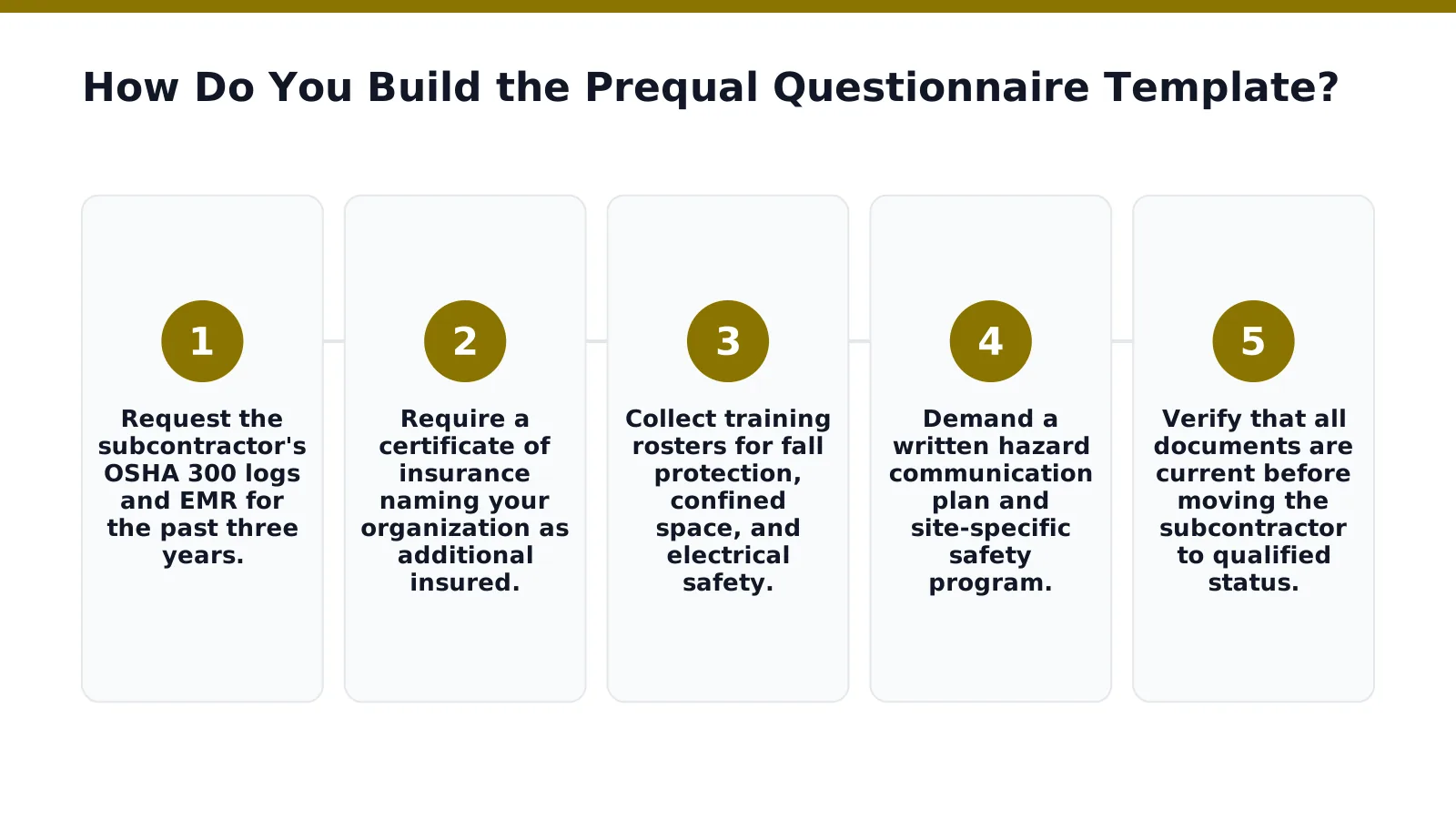
- Request the subcontractor's OSHA 300 logs and EMR for the past three years.
- Require a certificate of insurance naming your organization as additional insured.
- Collect training rosters for fall protection, confined space, and electrical safety.
- Demand a written hazard communication plan and site-specific safety program.
- Verify that all documents are current before moving the subcontractor to qualified status.

How Do You Screen Contractors Against Safety Records?
What Documents Should a Contractor Screening Process Verify?
- Collect safety documentation. Gather OSHA 300 logs, experience modification rates (EMRs), and written safety programs from every contractor. These records establish the baseline for evaluation.
- Configure requirements by risk profile. Hiring client requirements can be configured by location, level of risk, or specific designations. A roofing subcontractor demands stricter fall protection criteria than an interior finish contractor.
- Verify submissions against regulatory standards. Contractor screening tools should verify submitted documents against regulatory and hiring client requirements before approval. ISN's Review and Verification Services team reviews documents against these precise standards.
- Conduct expert job site audits. Expert job site audits are comprehensive evaluations designed to assess compliance with safety standards and identify potential hazards. Audits reveal whether documented programs translate into field practices.
- Monitor leading indicators continuously. Effective safety metrics help organizations monitor performance, identify improvements, and ensure regulatory compliance consistently. Track near-miss reports and inspection completion rates alongside lagging indicators.
How Do Audits Strengthen Subcontractor Safety Vetting?
How Do You Apply the Contractor Vetting Checklist On Site?
- Schedule the first walkthrough within the opening days of mobilization, while work practices are still forming.
- Observe active tasks against the checklist line items and record each deviation with a location and photo.
- Interview crew members to verify they understand the site-specific hazards and controls.
- Score findings using concrete health and safety metrics so managers can measure progress over time.
- Issue corrective actions with named owners and closure dates, then re-inspect to confirm resolution.
How Do On-Site Inspections Reinforce Safety Culture?
Where Do Contractor Screening Tools Fit After Award?
What Mistakes Undermine Subcontractor Safety Vetting?
Why does manual contractor tracking create hidden liability?
What metrics reveal a weak vetting program?
- Accepting expired insurance certificates without automated renewal tracking
- Skipping project-specific hazard assessments in favor of generic approvals
- Failing to verify training records against the actual scope of work