
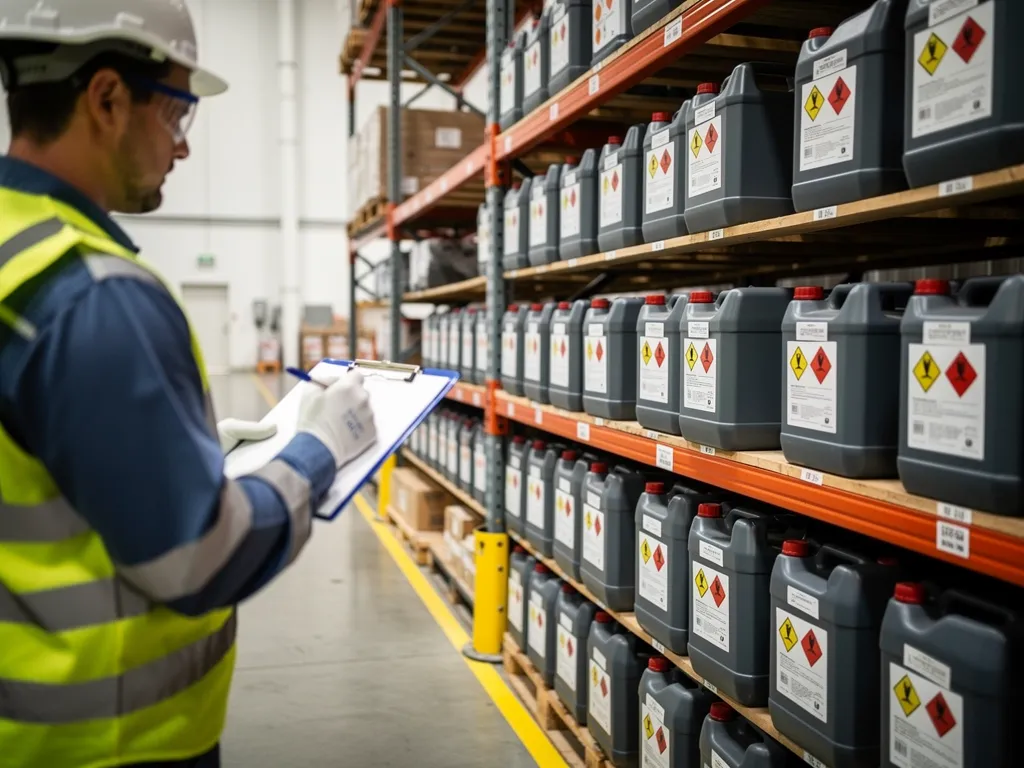
OSHA’s Hazard Communication Standard (HCS), aligned with the Globally Harmonized System (GHS), requires written programs, employee training, and proper labels. Rocky Zapata Safety Consulting provides compliance training, including 10-hour and 30-hour OSHA Outreach courses, to help organizations meet these requirements and reduce workplace incidents.

Key Takeaways

  • OSHA's Hazard Communication Standard requires a written program, chemical inventory, labeled containers, accessible safety data sheets, and documented training.
  • Hazard Communication remains a frequent offender on OSHA's top 10 violations list, making it critical to get right.
  • GHS alignment standardizes classification criteria and label elements, and safety data sheets follow a strict 16-section format.
  • OSHA mandates training upon initial assignment and whenever new hazards are introduced into the workplace.

What Does OSHA HazCom Compliance Require?

OSHA's hazard communication standard demands a written program, complete chemical inventory, properly labeled containers, accessible safety data sheets, and documented employee training. The standard now aligns with the Globally Harmonized System of Classification and Labeling of Chemicals (GHS), creating a unified method for classifying hazards and communicating them on labels and safety data sheets. Hazard Communication remains a frequent offender on OSHA's top 10 violations list, making it one of the administration's most critical standards to get right.

Compliance training forms the backbone of any effective workplace safety strategy. Workers need the knowledge and skills to handle chemicals safely and uphold regulatory standards. Without it, organizations face citation risk and preventable incidents.

What are the core elements of a compliant HazCom program?

A compliant program rests on five pillars. First, develop and maintain a written chemical safety program that documents how your facility meets each requirement. Second, build and update a chemical inventory management system listing every hazardous chemical present in the workplace. Third, ensure every container carries a GHS-aligned label with signal words, pictograms, hazard statements, and precautionary statements. Fourth, maintain accessible safety data sheets for each chemical and train employees on how to read them. Fifth, deliver initial and ongoing employee training covering hazard identification, protective measures, and SDS comprehension.

How does GHS alignment change compliance obligations?

GHS alignment standardizes classification criteria and label elements across borders. Manufacturers and importers must now classify chemicals according to specific health and physical hazard criteria. Labels require standardized signal words, pictograms, and hazard and precautionary statements. Safety data sheets follow a strict 16-section format. This uniformity simplifies msds ghc compliance and reduces confusion for workers who encounter chemicals from multiple suppliers.

What training does OSHA require for HazCom?

OSHA mandates training upon initial assignment and whenever new hazards are introduced. Our OSHA Outreach Training courses deliver this education through 10-hour and 30-hour formats. The 10-hour course suits entry-level workers. The 30-hour course covers broader safety topics and deeper hazard recognition. Both formats equip employees with knowledge of workplace safety, OSHA regulations, and individual responsibilities. A robust chemical exposure control plan integrates this training with engineering controls, administrative procedures, and personal protective equipment requirements.

What Prerequisites Should Employers Assemble First?

A written chemical safety program demands a complete inventory of every hazardous chemical on site. The hazard communication standard applies to almost all operations that handle, store, or use hazardous chemicals, and a recent analysis from Traceone found 5.6 hazard communication violations per 100,000 workers. Without this inventory, the entire program rests on an incomplete foundation.

Why Does a Chemical Inventory Come Before Everything Else?

The inventory drives every downstream requirement. Current safety data sheets and GHS-compliant labels must be on hand before training can begin. The HCS update provides a common approach to communicating hazard information on labels and safety data sheets. We cannot train workers on hazards we have not yet identified.

What Role Do Workplace Inspections Play in Preparation?

Workplace safety inspections and audits identify chemical hazards before the written program takes shape. We use these metrics through workplace safety inspections and audits to help Managers organizations identify hazards, meet OSHA compliance standards, and build measurable, proactive safety management frameworks across construction and manufacturing operations. We then build the chemical exposure control plan around real operational conditions, not assumptions.

How Should Employers Handle Multilingual Workforces?
Bilingual capability is a practical prerequisite in multicultural workforces. Rocky Zapata Safety Consulting offers a range of compliance training options designed to meet the diverse needs of businesses, including 10-hour and 30-hour OSHA Outreach courses. This step prevents critical gaps in comprehension that lead to violations and injuries.

Chemical inventory management and msds ghc compliance both depend on these foundational steps. Our industrial safety programs integrate these prerequisites into a structured launch sequence. Skipping any one of them introduces compliance risk that compounds as the program scales across facilities.

How Do You Build the Written Program Step by Step?

Building a compliant written program follows five sequential steps. Each step addresses a specific OSHA requirement and creates a defensible framework for workplace chemical safety.

What Goes Into the First Step of a Written Program?

The first step establishes the foundation. We draft the written hazard communication standard program and assign clear responsibility for chemical inventory management. Every container entering the facility must be accounted for and tracked over time. OSHA emphasizes that information about chemical identities and hazards must be available and understandable to workers. Without a designated owner, containers accumulate unlabeled and unmanaged.

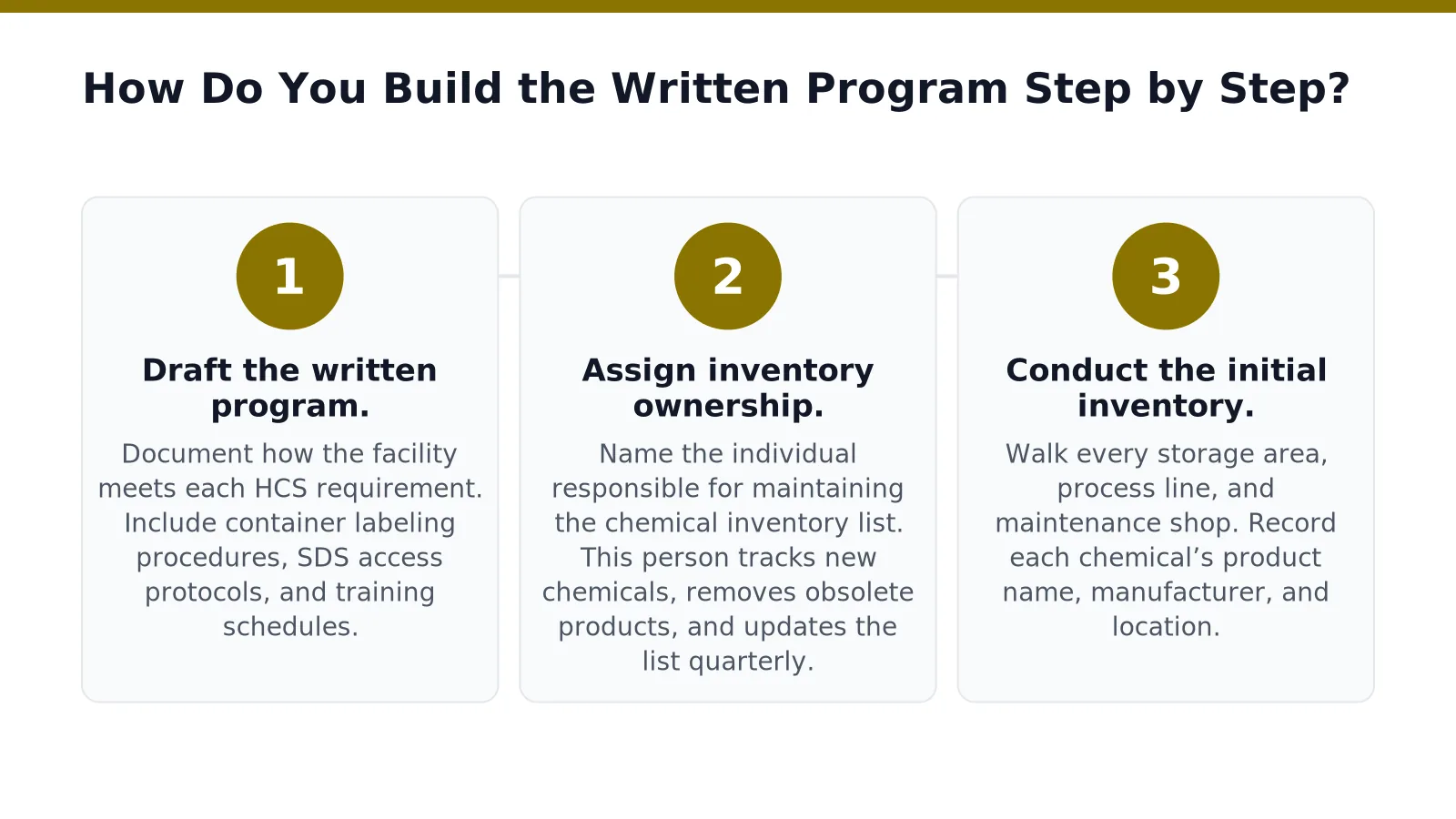
  1. Draft the written program. Document how the facility meets each HCS requirement. Include container labeling procedures, SDS access protocols, and training schedules.
  2. Assign inventory ownership. Name the individual responsible for maintaining the chemical inventory list. This person tracks new chemicals, removes obsolete products, and updates the list quarterly.
  3. Conduct the initial inventory. Walk every storage area, process line, and maintenance shop. Record each chemical’s product name, manufacturer, and location.

How Do We Achieve Full SDS and Label Compliance?

Step two verifies msds ghc compliance across the entire facility. We replace legacy material safety data sheets with GHS-aligned safety data sheets. The HCS update provides a common approach to classifying chemicals and communicating hazard information on labels and safety data sheets. We also confirm every secondary container carries a compliant label. A missing label on a spray bottle or transfer vessel creates immediate citation risk.

What Must a Chemical Exposure Control Plan Address?

Step three writes the chemical exposure control plan. Chemicals present physical hazards like fires and explosions. They also present health hazards such as respiratory issues, skin irritation, and long-term diseases. Our plan documents both categories for each chemical on site. It specifies engineering controls, PPE requirements, and emergency procedures tied to specific work areas.

How Does Worker Training Fit Into the Program?

Step four delivers worker training. Employees must understand the hazards and their individual responsibilities. Our OSHA Outreach Training courses equip employees with knowledge regarding workplace safety, OSHA regulations, and individual responsibilities towards maintaining a safe work environment. Training covers SDS interpretation, label reading, and spill response.

How Often Should the Program Be Reviewed?

Step five schedules recurring workplace safety inspections and audits. Expert job site audits are comprehensive evaluations designed to assess compliance with safety standards and identify potential hazards. We review the written program annually and after any process change that introduces new chemicals.

How Do You Verify and Document Ongoing Compliance?

Verification requires measurement, not assumption. We confirm that a chemical safety program works by tracking defined safety KPIs and closing every gap those metrics expose. Written policies alone prove nothing.

Managers should track inspection completion rates and corrective action closure times to confirm the program is functioning, not merely written. Injury Frequency Rate and near-miss reporting round out the core indicators we recommend. These metrics show where a hazard communication standard program is holding and where it is slipping.

Data-driven safety programs enable continuous improvement of workplace health and safety standards organization-wide. Effective safety metrics help organizations monitor performance, identify improvements, and ensure regulatory compliance consistently. Our team builds these reporting rhythms into every engagement, and our guidance on safety KPIs for managers details the indicators worth tracking.

How Do You Document Compliance Over Time?

Documentation turns a snapshot into a defensible record. We recommend a simple, repeatable sequence:

  1. Record each inspection with its completion date and findings.
  2. Log every corrective action with an owner and a closure deadline.
  3. Review near-miss reports at each safety meeting.
  4. Audit chemical inventory management records against current labels and safety data sheets.

Complying with HCS not only helps employers avoid costly fines, it also improves operational efficiency, builds employee confidence, and reduces the risk of chemical-related accidents. That outcome depends on consistent records, not a one-time binder.

How Often Should We Reverify Compliance?

We set review intervals around risk, not convenience. High-hazard operations warrant more frequent checks than low-exposure sites. The discipline matters more than the calendar: every review produces a dated record and a named owner for each open item.

What Are the Most Common HazCom Mistakes?

The most common HazCom mistake is treating hazard communication as paperwork rather than a working safety system. Hazard Communication remains a frequent offender on OSHA's top 10 violations list, despite being one of the administration's most important standards. That gap carries real cost. A chemical safety program that exists only in a binder leaves workers exposed and employers open to citations.

Four failures account for most of the gap we find in the field:

  1. Stale documentation. The Hazard Communication Standard update was designed to deliver cost savings for businesses that regularly handle, store, and use hazardous chemicals. Companies that never refresh safety data sheets and labels forfeit those savings.
  2. Skipping bilingual delivery. In Miami's multicultural landscape, the importance of bilingual training cannot be overlooked. Monolingual delivery leaves part of the workforce without the right to understand the hazards they handle.
  3. Unverified consulting partners. Understanding the components and services offered by prominent safety consultants significantly impacts a company's operational integrity. Vet qualifications before signing.
  4. Weak chemical inventory management. An inventory nobody updates cannot support accurate labeling or training.

How Do We Fix a Stale HazCom Program?

We start with a documented inventory, then rebuild labels and safety data sheets against it. Our safety training curriculum design process ties each chemical to the workers who handle it. MSDS GHC compliance becomes a maintained routine, not an annual scramble.

Does Training Alone Close the Gap?

No. Training without a written chemical exposure control plan leaves hazards unmanaged. We pair instruction with controls, then audit both.

FAQ

What are the five core elements of a compliant HazCom program?

A written program, chemical inventory, GHS-aligned labels, accessible safety data sheets, and initial and ongoing employee training.

What training does OSHA require for Hazard Communication?

OSHA mandates training upon initial assignment and whenever new hazards are introduced into the workplace.

How does GHS alignment affect safety data sheets?

Safety data sheets follow a strict 16-section format, standardizing classification criteria and label elements across borders.

Conclusion

A compliant HazCom program depends on a maintained system, not a one-time binder. Start with a documented chemical inventory, rebuild labels and safety data sheets against it, and pair worker training with a written chemical exposure control plan. Then audit both on a schedule set by risk. That sequence closes the gap between paperwork and practice, protects workers from chemical hazards, and keeps the facility ready for inspection.